<?xml version="1.0" encoding="UTF-8"?>
<feed xmlns="http://www.w3.org/2005/Atom"  xmlns:media="http://search.yahoo.com/mrss/" xmlns:dc="http://purl.org/dc/elements/1.1/" xmlns:itunes="http://www.itunes.com/dtds/podcast-1.0.dtd" xmlns:geo="http://www.w3.org/2003/01/geo/wgs84_pos#" xmlns:georss="http://www.georss.org/georss" xmlns:photo="http://www.pheed.com/pheed/">
 <title>European Interreligious Forum For Religious Freedom</title>
 <subtitle><![CDATA[EIFRF is an interfaith group, which Steering Committee includes religious leaders from various faiths and from various European countries, united in order to:
• Promote freedom of religion and belief
• Promote religious tolerance
• Promote interfaith dialog
• Promote knowledge of religions]]></subtitle>
 <link rel="alternate" type="text/html" href="https://www.eifrf-articles.org" />
 <link rel="self" type="text/xml" href="https://www.eifrf-articles.org/xml/atom.xml" />
 <id>https://www.eifrf-articles.org/</id>
 <updated>2026-10-18T03:16:08+02:00</updated>
 <generator uri="http://www.wmaker.net">Webzine Maker</generator>
  <geo:lat>48.8903273</geo:lat>
  <geo:long>2.3263728</geo:long>
  <icon>https://www.eifrf-articles.org/favicon.ico</icon>
  <entry>
   <title>Hungarian governmental party leader crackdown on Islam</title>
   <updated>2017-11-30T15:11:00+01:00</updated>
   <id>https://www.eifrf-articles.org/Hungarian-governmental-party-leader-crackdown-on-Islam_a215.html</id>
   <category term="Religious Freedom" />
   <photo:imgsrc>https://www.eifrf-articles.org/photo/art/imagette/18523416-22650426.jpg</photo:imgsrc>
   <published>2017-11-28T20:28:00+01:00</published>
   <author><name>EIFRF</name></author>
   <content type="html">
    <![CDATA[
     <div style="position:relative; float:left; padding-right: 1ex;">
      <img src="https://www.eifrf-articles.org/photo/art/default/18523416-22650426.jpg?v=1511898468" alt="Hungarian governmental party leader crackdown on Islam" title="Hungarian governmental party leader crackdown on Islam" />
     </div>
     <div>
      While interviewed on a pro-government television channel in Hungary on November 3, 2017,&nbsp;Fidesz parliamentary delegation leader Gergely Gulyás declared that “there will be no mosques in Hungary”, and added that “from the perspective of our own security, mosques would have a negative impact”.&nbsp; <br />   <br />  Gulyás was speaking to government propagandist Zsolt Bayer,&nbsp;a founding member of governing Fidesz party known for making offensive and racist statements and comments. During the TV show, Bayer said that “the problem is that now you almost have to say with boring grayness that, of course, Islamist, Jihadist, Islamic State, when did he get there, where was he radicalized…We know that next week, in two weeks, in a month, it’s going to happen again somewhere. We know this, but still nothing is happening.” <br />  Then Gulyas answered "“Western Europe has not done anything against this danger…Wherever radical Islam raises its head and is allowed to take root, these kinds of acts can occur at any moment.” This is the moment where Bayer said&nbsp;“Wherever there’s a mosque, there’s a problem”, and Gulyas added:&nbsp;“That’s right. There will be no mosques in Hungary…There is such an initiative. We can’t change our position on this.” <br />   <br />  &nbsp;
     </div>
     <br style="clear:both;"/>
    ]]>
   </content>
   <link rel="alternate" href="https://www.eifrf-articles.org/Hungarian-governmental-party-leader-crackdown-on-Islam_a215.html" />
  </entry>
  <entry>
   <title>Interview: Top data protection international expert on the Hungarian Scientology case</title>
   <updated>2017-11-04T18:48:00+01:00</updated>
   <id>https://www.eifrf-articles.org/Interview-Top-data-protection-international-expert-on-the-Hungarian-Scientology-case_a211.html</id>
   <category term="Religious Freedom" />
   <photo:imgsrc>https://www.eifrf-articles.org/photo/art/imagette/18022446-22337259.jpg</photo:imgsrc>
   <published>2017-11-04T18:16:00+01:00</published>
   <author><name>EIFRF</name></author>
   <content type="html">
    <![CDATA[
Prof. Dr. Jos Dumortier is an internationally renowned top expert in data protection. Since 1993, he has been a Professor of Law at the Law Faculty of the University of Leuven, where he teaches data protection. Back in the 90s', he was one of the first Belgian lawyers to deal with data protection, long before other lawyers started practising this area of law. At that time he was appointed by the Belgian Government to draft the Belgian Data Protection Act. He very frequently acts as counsel to the Belgian Federal Government, the Belgian Federal Public Service of Information and Communication Technology, the Flemish, Walloon and Brussels Governments, the European Commission, the Dutch government and various other Belgian and international public sector bodies to draft contracts or provide advice in these areas of law.     <div style="position:relative; float:left; padding-right: 1ex;">
      <img src="https://www.eifrf-articles.org/photo/art/default/18022446-22337259.jpg?v=1509816847" alt="Interview: Top data protection international expert on the Hungarian Scientology case" title="Interview: Top data protection international expert on the Hungarian Scientology case" />
     </div>
     <div>
      <strong><em>EIFRF interviewed him on the "Scientology case" in Hungary, where the Scientologists are the target of a campaign from the Hungarian government, which decided to go against them via the National Data Protection Agency. This agency then&nbsp;decided to arbitrarily seize Church of Scientology parishioner files,&nbsp;including priest-penitent files.&nbsp;</em></strong> <br />   <br />  <strong><u>EIFRF:</u> The Hungarian Data Protection Agency and Hungarian National Bureau of Investigation are pretending that the folders that the Church of Scientology uses for monitoring the spiritual progresses of its parishioners, violate the Data Protection regulations of the European Union. What do you think about it?</strong> <br />  &nbsp; <br />  <u><strong>Jos Dumortier:</strong></u> From a strictly legal point of view, these folders are outside the scope of the European data protection legislation. The European legislator never aimed at introducing formal legal rules for handwritten notes, taken by someone on a sheet of paper during a meeting, an interview or, as in the Church of Scientology, an auditing session. <br />  Data protection laws are intended to protect individuals against automated or manual means which enable easy and rapid retrieval of personal information about a specific individual, even if this information is stored in different sources. This is primarily a characteristic of computerised files. Only if manual, paper-based, methods enable similar retrieval, linking or associations, then these methods are also included in the scope of data protection legislation. <br />  Extending this scope to all kinds of handwritten notes or other paper documents, would lead to absurd consequences. The Hungarian data protection supervisor also seems to think that paper-based dossiers are submitted to the European data protection rules if the documents are properly arranged in dossiers, or if the dossiers are stored in alphabetical order. The consequence of this reasoning is that it would suffice to bring some disorder into your paper documents, to escape from the law! It is evident that this has never been the objective of the European legislator.&nbsp;&nbsp; <br />   <br />  <strong><u>EIFRF:</u> This criticism against the folders kept by the Church of Scientology has already been raised by the Prosecutor office in Belgium. What has been the final decision of the Belgian courts, did they found that the Church of Scientology was guilty of a crime related to data protection? Are there other instances where the folders kept by the church of scientology to monitor the spiritual progresses of its followers have been examined by official bodies?</strong> <br />   <br />  <strong><u>Jos Dumortier:</u></strong> The public prosecutor in Belgium attempted to get the Church of Scientology sanctioned on the basis of similar accusations as the Hungarian data protection supervisor today. The argument that the paper files held by the Church of Scientology are regulated by the provisions of the data protection law, has been rejected, not only by the Brussels tribunal in the Church of Scientology case, but also by a Belgian Court of Appeal in a similar case about another religious organisation (Jehovah Witnesses).  <blockquote>  <div style="padding: 10px 0px; text-align: center; font-size: 1.2em; font-style: italic;">Also in other countries, like Sweden, the data protection authorities have, likewise, judged that the paper files held by the Church of Scientology are outside the scope of the European data protection law.&nbsp;</div>  </blockquote>  Also the Belgian highest court, the “Court of Cassation”, has judged&nbsp; that, to bring personal data contained in paper dossiers within the scope of the data protection legislation, three criteria need to be fulfilled: <br />  1) the data themselves (not the documents only) need to be structured according to specific criteria, <br />  2) these criteria need to relate to individual persons, and <br />  3) the criteria should allow easy access to the personal data. <br />  This case dealt with HR dossiers held by the Ministry of Justice! The decisions of the Belgian courts are perfectly in line with recital 27 of the European data protection Directive, which states that: <em>“files or sets of files as well as their cover pages, which are not structured according to specific criteria, shall under no circumstances fall within the scope of this Directive”</em>. <br />   <br />  Also in other countries, like Sweden, the data protection authorities have, likewise, judged that the paper files held by the Church of Scientology are outside the scope of the European data protection law. <br />  &nbsp; <br />  <strong><u>EIFRF:</u> On the other side, do you think that the fact that the Hungarian authorities seized and consulted these folders containing personal data protected by Priest-Parishioner privilege, could be a problem, or even a crime based on personal data protection EU law?</strong> <br />   <br />  <strong><u>Jos Dumortier:</u></strong> One of the most important recitals of the European General Data Protection Regulation is Recital 4. It is stated as follows: <em>“The processing of personal data should be designed to serve mankind. The right to the protection of personal data is not an absolute right; it must be considered in relation to its function in society and be balanced against other fundamental rights, in accordance with the principle of proportionality. This Regulation respects all fundamental rights and observes the freedoms and principles recognised in the Charter as enshrined in the Treaties, in particular the respect for private and family life, home and communications, the protection of personal data, freedom of thought, conscience and religion, freedom of expression and information, freedom to conduct a business, the right to an effective remedy and to a fair trial, and cultural, religious and linguistic diversity”</em>. Consequently, data protection supervisory authorities are requested to respect a fair balance between the personal data protection rights of an individual and freedom of religion.    <blockquote>  <div style="padding: 10px 0px; text-align: center; font-size: 1.2em; font-style: italic;">It leads to the paradoxical consequence, that the individual privacy and personal data protection rights of the parishioners are damaged as never before by an authority which has been established precisely to protect those privacy rights!</div>  </blockquote>  In the Hungarian case against the Church of Scientology this “fair balance” is completely absent. It leads to the paradoxical consequence, similar to&nbsp; what we experienced in the Belgian Scientology court case, that the individual privacy and personal data protection rights of the parishioners are damaged as never before by an authority which has been established precisely to protect those privacy rights!&nbsp; <br />  In some other countries, such unwanted situations have been anticipated by legislators in a better way than in Europe. The Japanese data protection law, for example, explicitly states that an investigation by the data protection authority <em>“in the course of requiring the submission of material or of conducting an onsite inspection should not hinder the freedom of expression, freedom of academia, freedom of religion, and freedom of political activity”</em>. Similar to Europe, the Japanese legislator has attributed very large powers to an independent data protection supervisory authority, but at the same time, ensured that these powers can never be (ab)used to hinder the exercise of fundamental rights and freedoms.    <div>&nbsp;</div>    <div>&nbsp;</div>    <div>&nbsp;</div>    <div>&nbsp;</div>    <div>&nbsp;</div>  

     </div>
     <br style="clear:both;"/>
    ]]>
   </content>
   <link rel="alternate" href="https://www.eifrf-articles.org/Interview-Top-data-protection-international-expert-on-the-Hungarian-Scientology-case_a211.html" />
  </entry>
  <entry>
   <title>Scientologists protest violation of their right to religious freedom in Hungary</title>
   <updated>2017-10-18T23:10:00+02:00</updated>
   <id>https://www.eifrf-articles.org/Scientologists-protest-violation-of-their-right-to-religious-freedom-in-Hungary_a210.html</id>
   <category term="Religious Freedom" />
   <photo:imgsrc>https://www.eifrf-articles.org/photo/art/imagette/17726394-22133294.jpg</photo:imgsrc>
   <published>2017-10-18T21:25:00+02:00</published>
   <author><name>EIFRF</name></author>
   <content type="html">
    <![CDATA[
     <div style="position:relative; text-align : center; padding-bottom: 1em;">
      <img src="https://www.eifrf-articles.org/photo/art/default/17726394-22133294.jpg?v=1645637427" alt="Scientologists protest violation of their right to religious freedom in Hungary" title="Scientologists protest violation of their right to religious freedom in Hungary" />
     </div>
     <div>
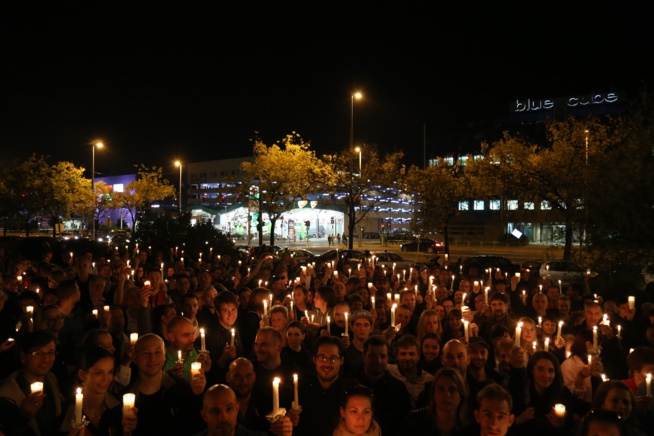
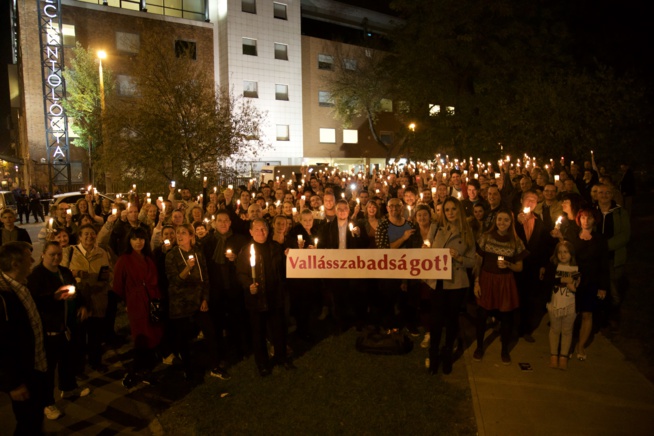
      Today in Budapest, several hundreds of Scientologists gathered peacefully with candles before their Church in Budapest to protest what they called an outrageous and wholesale violation of the human rights of all Scientologists in the country. Indeed, today, 50 police officers of the National Investigation Office raided the Church of Scientology of Budapest and 17 Scientology missions in Hungary, saying that it was related to “a suspected misuse of personal information”. <br />   <br />  Since 2012, when a widely-disputed law on churches and religious matters went into force, Hungary has been increasingly criticized by human rights institutions for its crackdown on religious minorities throughout the country. Even the European Courts of Human Rights determined in 2014 that the Hungarian Church Act (of 2012) violated the right to freedom of thought, conscience and religion and freedom of association protected by the European Convention on Human Rights. This decision became final by decision of the Grand Chamber of the European Court in September 2014. <br />   <br />  Since that date, Hungary refused to abide by the decision, and increased its crackdown on religious minorities as Scientologists, as well as other non-Catholic Christian, Jewish and Muslim denominations and eastern religions, in disrespect of the human rights standards of the Council of Europe, the European Union and the OSCE.
     </div>
     <br style="clear:both;"/>
     <div style="position:relative; text-align : center; padding-bottom: 1em;">
      <img src="https://www.eifrf-articles.org/photo/art/default/17726394-22134150.jpg?v=1508360668" alt="Scientologists protest violation of their right to religious freedom in Hungary" title="Scientologists protest violation of their right to religious freedom in Hungary" />
     </div>
     <div>
      
     </div>
     <br style="clear:both;"/>
     <div style="position:relative; text-align : center; padding-bottom: 1em;">
      <img src="https://www.eifrf-articles.org/photo/art/default/17726394-22134284.jpg?v=1508360813" alt="Scientologists protest violation of their right to religious freedom in Hungary" title="Scientologists protest violation of their right to religious freedom in Hungary" />
     </div>
     <div>
      
     </div>
     <br style="clear:both;"/>
     <div style="position:relative; text-align : center; padding-bottom: 1em;">
      <img src="https://www.eifrf-articles.org/photo/art/default/17726394-22134320.jpg?v=1508360945" alt="Scientologists protest violation of their right to religious freedom in Hungary" title="Scientologists protest violation of their right to religious freedom in Hungary" />
     </div>
     <div>
      
     </div>
     <br style="clear:both;"/>
     <div style="position:relative; text-align : center; padding-bottom: 1em;">
      <img src="https://www.eifrf-articles.org/photo/art/default/17726394-22134349.jpg?v=1508361033" alt="Scientologists protest violation of their right to religious freedom in Hungary" title="Scientologists protest violation of their right to religious freedom in Hungary" />
     </div>
     <div>
      
     </div>
     <br style="clear:both;"/>
    ]]>
   </content>
   <link rel="alternate" href="https://www.eifrf-articles.org/Scientologists-protest-violation-of-their-right-to-religious-freedom-in-Hungary_a210.html" />
  </entry>
</feed>